 Codex Design
E-commerce website design template.
A complete online store template: home page, product listing with filters, product page and shopping cart, for a sample handmade ceramics shop called Morrow. This ecommerce website template is a React project with shadcn/ui and Tailwind CSS v4, and every price, count and cart total comes from one data file, so Codex or Claude Code can clone it, swap in your products, and keep building.
Updated November 21, 2026
Website · 4 pages · Free and open source
01Home page 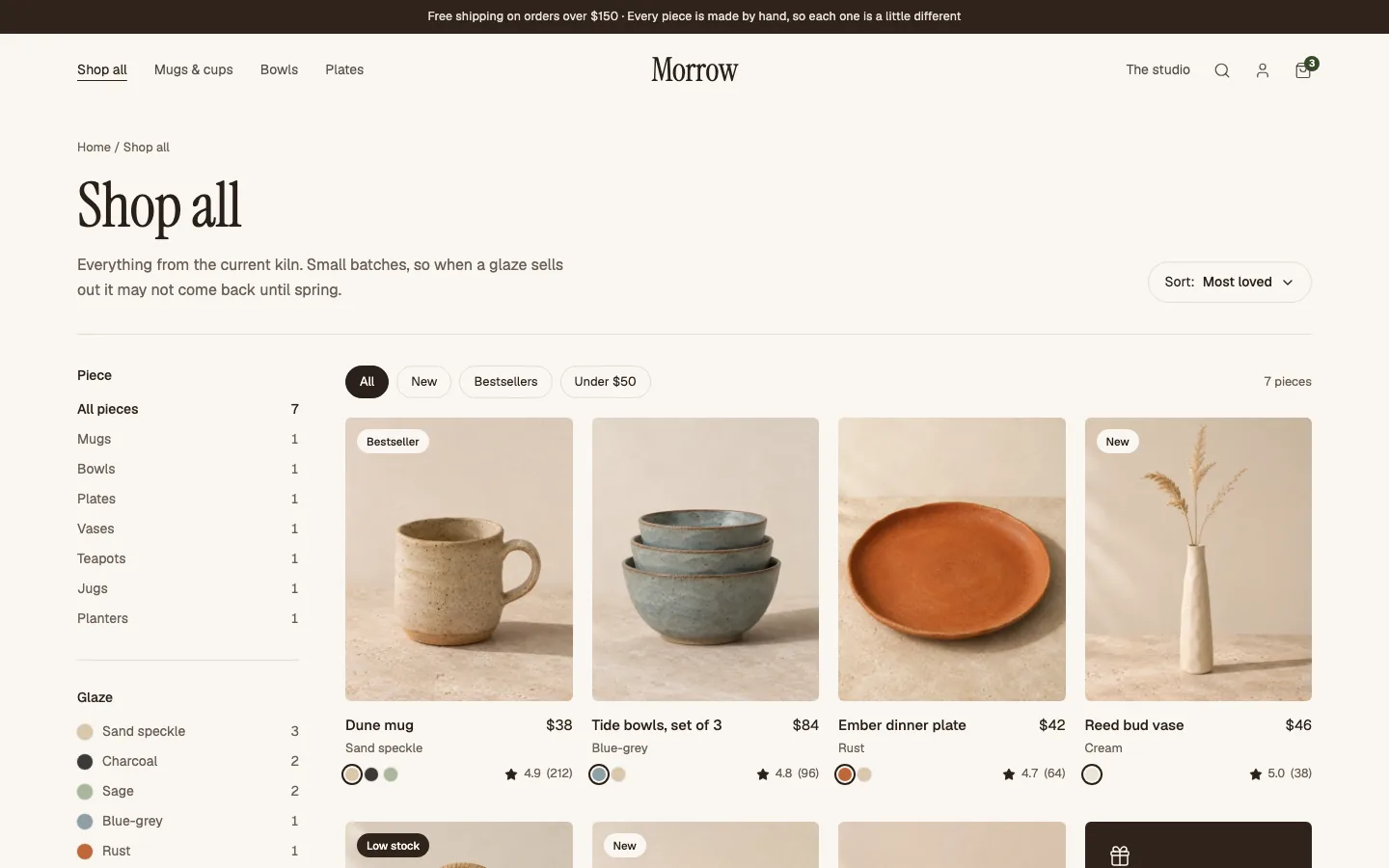
02Product listing page 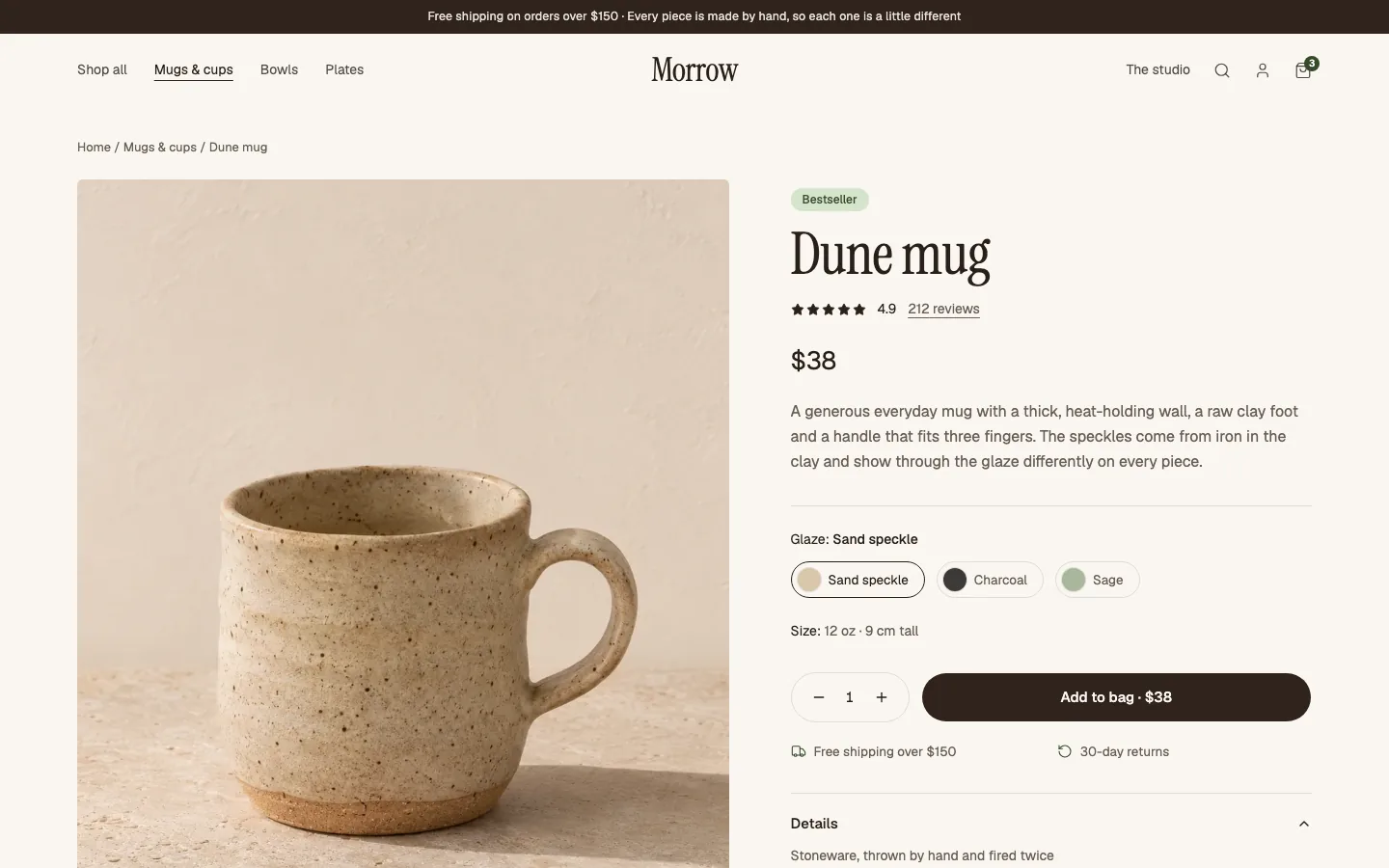
03Product page 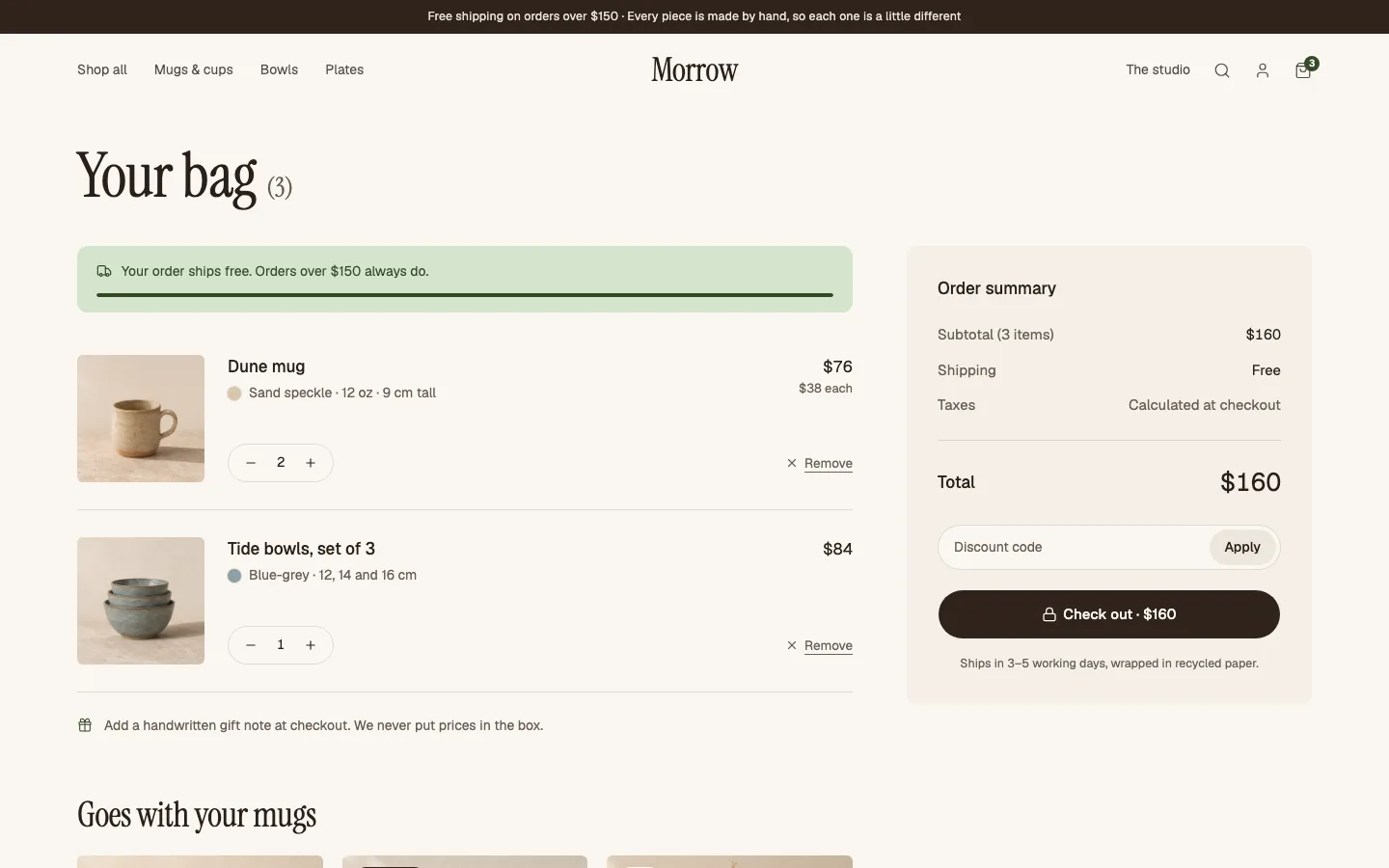
04Shopping cart
Clone it
npx degit ummydev/ui-templates/shadcn/ecommerce my-app
Copies just this template into a new folder, without the rest of the repository.
Make it yours
This is the E-commerce website template from codexdesign.io. Rename it to [your product], replace the sample data with [your features], and keep every screen on the design system in DESIGN.md.
Paste this into Codex or Claude Code in the new folder.
- Built with
- React · shadcn/ui · Tailwind CSS v4 · Lucide icons
What’s in the template
| Page | What’s on it | Components used |
|---|---|---|
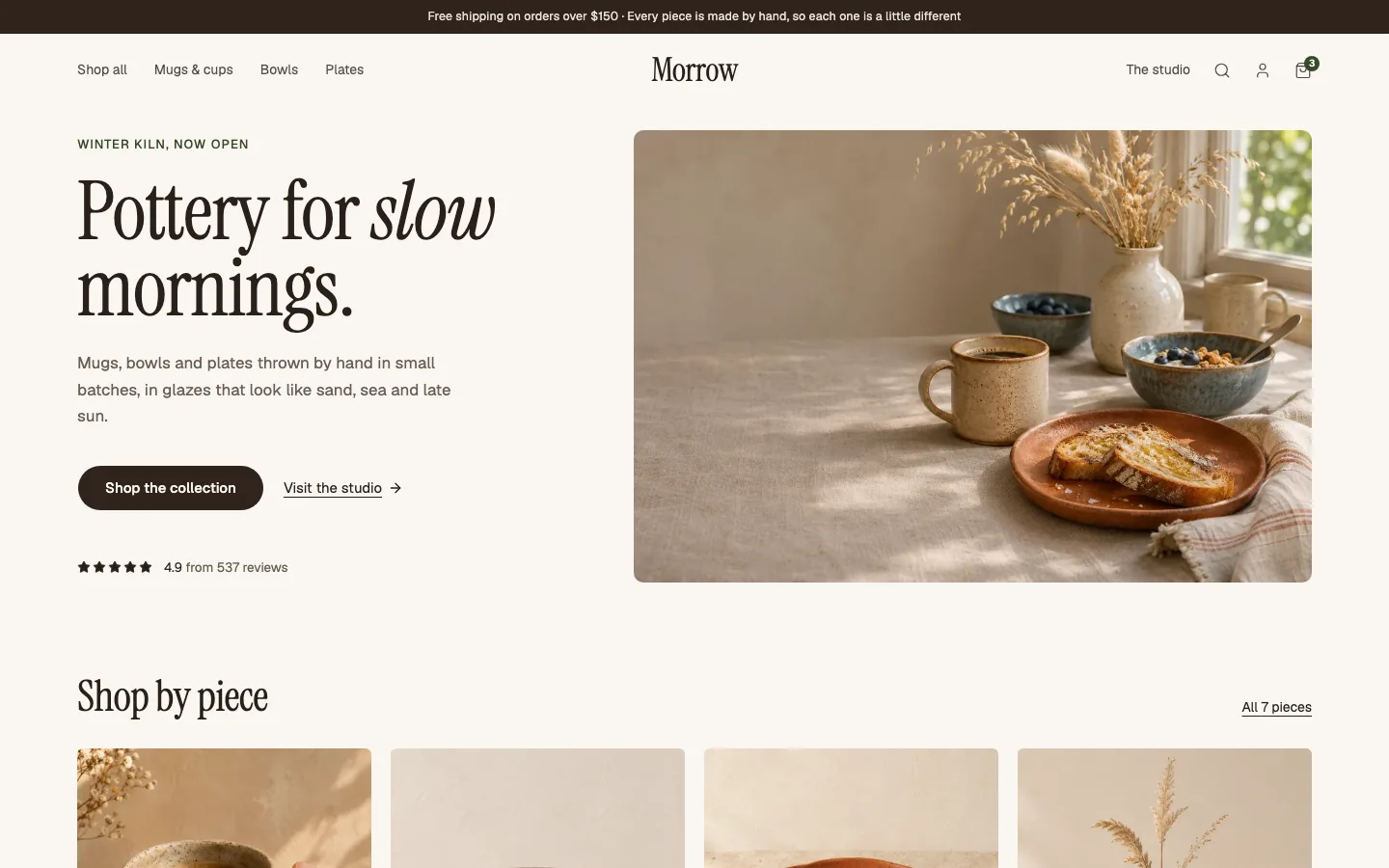
| Home page | A hero with the shop’s rating, shop by piece with starting prices, four bestsellers, the studio story, three reviews and a newsletter | shadcn/ui Button, Tailwind product cards and bands, Lucide icons |
| Product listing page | Filters for piece, glaze and price with counts, an in-stock toggle, quick-filter chips, sorting and all seven products in a grid | Tailwind filter sidebar, chips and product cards, Lucide icons |
| Product page | A large photo with two detail shots, rating, price, glaze and size, quantity and Add to bag, accordions, a review and pieces to pair | shadcn/ui Button, Tailwind glaze pills, stepper and accordions, Lucide icons |
| Shopping cart | Free-shipping progress, two line items with quantity and Remove, three cross-sells and an order summary with a discount code | shadcn/ui Button, Tailwind line items and summary card, Lucide icons |
Every page shares the same frame: an espresso announcement bar (“Free shipping on orders over $150 · Every piece is made by hand, so each one is a little different”), a header with Shop all, Mugs & cups, Bowls, and Plates on the left, the Morrow wordmark in the middle, and The studio, search, account, and the bag with its count of 3 on the right, and a footer with the studio’s line and Shop, Help, and Studio links.
Home page
The home page opens with “Winter kiln, now open” and the headline “Pottery for slow mornings.”, a line about mugs, bowls, and plates thrown by hand, a Shop the collection button, a Visit the studio link, and 4.9 stars from 537 reviews, next to a large photo of a breakfast table set with the shop’s stoneware. Shop by piece has four tiles with starting prices (Mugs & cups from $38, Bowls from $84, Plates from $42, Vases from $46) and a link to all 7 pieces. Most loved shows four product cards, the Dune mug, Tide bowls, Hollow teapot, and Brook jug, each with its photo, a Bestseller, Low stock, or New badge, price, glaze swatches, and rating. Then come a studio band with a photo of hands shaping a bowl on the wheel (“Two people, one wheel, and a kiln that runs on Sundays.”), three customer reviews from Leeds, Lyon, and Toronto that each name the piece they bought, and a dark newsletter band with an email field and Join the list.
Product listing page
The product listing page, Shop all, has a breadcrumb, the title, a line about small batches, and a Sort: Most loved menu. The filter sidebar lists every piece with its count (All pieces 7, and one each of mugs, bowls, plates, vases, teapots, jugs, and planters), the seven glazes with a swatch and the number of products that come in each (Sand speckle and Cream 3, Charcoal and Sage 2, Blue-grey, Rust, and Clay pink 1), a price range from $38 to $128, and an In stock only toggle. Above the grid are quick-filter chips (All, New, Bestsellers, Under $50) and “7 pieces”. The four-column grid shows all seven products as 4:5 cards, and the eighth tile is a dark gift card offer: “Not sure which glaze?”, gift cards from $25. The filters are a static layout, so they don’t change the grid yet; ask your agent to connect them to your products.
Product page
The product page is the Dune mug: a large 4:5 photo with two square detail shots below, one in a hand and one on the breakfast table. Beside it are a Bestseller badge, the name, 4.9 stars and 212 reviews, the price of $38, and a short story about the iron speckles in the clay. Glaze pills offer Sand speckle, Charcoal, and Sage, the size reads 12 oz · 9 cm tall, and a quantity stepper sits next to a full-width Add to bag · $38 button, with free shipping over $150 and 30-day returns below. Accordions hold Details (open), Care, and Shipping & returns; a review from Hannah K. in Leeds follows, and Set the table suggests four more pieces.
Shopping cart
The shopping cart, Your bag (3), holds two Dune mugs in Sand speckle ($76, $38 each) and one set of Tide bowls in Blue-grey ($84). A full progress bar says the order ships free, since orders over $150 always do. Each line has a quantity stepper and Remove, a note offers a handwritten gift message, and Goes with your mugs suggests the Ember dinner plate, Hollow teapot, and Reed bud vase. The order summary shows a subtotal of $160 for 3 items, free shipping, taxes calculated at checkout, a total of $160, a discount code field, and a Check out · $160 button. The template stops there: there is no checkout page or payment step behind the button.
How it’s built
The sample data is one made-up ceramics shop. Every page reads from src/data.ts, and the numbers are computed from it, so the pages agree: the 537 reviews on the home page are the seven products’ reviews added up, the “from” prices are the lowest price in each category, the sidebar counts and the $38 to $128 price range come from the product list, and the cart’s $160 subtotal is two $38 mugs and the $84 bowls. Shipping is free because $160 is over the $150 threshold in the same file; below it, the cart charges $9 and the bar shows how much more to add. All names, products, reviews, and prices are fictional.
The product photos are original. They were made for this template with AI image generation, not taken from a stock library or another shop, and they are free to use with the template. They live in public/images; swap in your own at the same aspect ratios (square and 4:5 for products, 3:2 for the hero).
Each page is a React component (src/home.tsx, src/shop.tsx, src/product.tsx, and src/cart.tsx) inside a shared layout in src/layout.tsx, which holds the header, the footer, the product card, and the star rating. The pages are laid out 1440 pixels wide for a desktop screen; open /?page=home, /?page=shop, /?page=product, or /?page=cart to switch between them. The only shadcn/ui component it imports is Button, used on the home page, product page, and cart: the cards, filters, chips, and stepper are plain Tailwind, and the icons are Lucide. The Morrow theme is shadcn’s CSS variables in src/index.css, plus a sage and an oat color of its own, with Instrument Serif and Geist installed from Fontsource. It runs with Vite: npm install, then npm run dev.
Use it with Codex or Claude Code
Copy just this template from the ui-templates repository:
npx degit ummydev/ui-templates/shadcn/ecommerce my-shop
cd my-shop && npm install && npm run dev
Then ask your agent to make it yours:
This folder is an e-commerce website template in React, shadcn/ui and Tailwind. Turn it into [your shop], selling [your products]. Keep DESIGN.md and the theme in src/index.css as the design system, replace the products, cart and reviews in src/data.ts with [your products], replace the photos in public/images with yours at the same aspect ratios, and keep every count and total computed from the data. Then make the filters and the cart work, and connect it to [your store backend or payment provider].
Because the design system is written down in DESIGN.md, the pages your agent adds next, such as checkout, an account page, or the studio story and journal linked in the footer, will match the four it starts with.
Built on the Morrow design system
The template uses Morrow, a design system for online stores: oat paper, espresso ink, one sage accent, Instrument Serif headlines with Geist for everything else, and 6px corners on photos, 10px on cards, and pill buttons, without shadows, gradients, or glass. Its page has a live preview, the full DESIGN.md, and a shadcn theme with light and dark colors.
Frequently asked questions
Is this e-commerce template free?
Yes. It’s open source under the MIT license, for personal and commercial projects, and the product photos, made for the template, are free to use with it.
Can I connect it to Shopify or Stripe?
Not out of the box. It’s a front-end template: no payments, store backend, inventory, or orders are connected, and the Check out button doesn’t lead anywhere yet. You or your agent would wire that up yourself, for example by loading products and the cart from Shopify through its Storefront API, or by sending the bag to Stripe Checkout for payment. Every price and total is read from src/data.ts, so that file is where real data replaces the sample.
Do the filters and the cart work?
Not yet. The pages are a static layout: the filters, chips, and sort don’t change the grid, and Add to bag, the quantity steppers, and Remove don’t change the cart, whose totals are computed from the sample cart in src/data.ts. Ask your agent to add the state, or to connect them to your store.
How do I use it with Codex or Claude Code?
Copy it with npx degit ummydev/ui-templates/shadcn/ecommerce my-shop, open the folder in Codex or Claude Code, and paste the prompt above with your shop filled in. The agent reads DESIGN.md for the design system and src/data.ts for the sample products, so it can swap in yours and add new pages that match the four it starts with.
Can I use it with Next.js?
Yes. It’s a Vite project, but the parts are standard React, shadcn/ui, and Tailwind CSS v4, so your agent can move the pages, src/layout.tsx, the Button in src/components/ui, and the theme in src/index.css into a Next.js app. Ask it to keep DESIGN.md so the design survives the move.
Does it work on a phone?
Not yet. The four pages are laid out for a 1440-pixel desktop screen. Ask your agent to add a phone layout before you launch the shop.
Is there a dark theme?
Not in the template, which is designed in light mode. The Morrow shadcn theme on the design system page includes dark colors to start from.