 Codex Design
GPT-6.2 Astra vs Sol for UI design.
OpenAI released GPT-6.2 Astra and GPT-6.2 Sol on November 17, 2026, and both are in Codex today. OpenAI says Astra “builds frontends that look and work better”. We gave both the same three UI prompts we used for GPT-6.1 and Claude Fable 5.2: a landing page, a SaaS dashboard, and a mobile app screen, with no design direction. Here is what came out.
Updated November 18, 2026 · 7 min read
The short answer
- Astra is faster; Sol is more careful. Astra finished each screen in 1:49 to 2:20. Sol took 3:34 to 4:44 and more tokens, but its pages rendered exactly as intended.
- Astra’s headings broke in all three screens. It styled them in its own CSS and then loaded Tailwind from the CDN, whose reset shrank every heading to body size. Astra’s summaries never mentioned checking the page in a browser. Sol said when it hadn’t, and on the mobile screen it opened the page in Chromium to check.
- The emoji icons are gone. GPT-6.1 put emoji icons in all six of its screens. GPT-6.2 used line icons everywhere; the checker only flagged ✓ and ✦ text symbols.
- Sol still defaults to the GPT-6.1 look: sage green, DM Sans and Manrope on the landing page. On the mobile screen both models went dark with lavender.
- Against Claude Fable 5.2: Fable’s screens had fewer problems and more real content, it was about as fast as Astra (1:39 to 1:55 a screen, in Claude Code), and it costs the same per token. With no direction, none of the three has taste you can rely on.
What’s new in GPT-6.2
| GPT-6.2 Astra | GPT-6.2 Sol | |
|---|---|---|
| Released | November 17, 2026 | November 17, 2026 |
| For | The hardest projects | Everyday work, OpenAI’s go-to |
| API price | $8 / $40 per million input / output tokens | $2 / $10, same as GPT-6.1 Sol |
| Cached input | $0.40 per million | $0.10 per million |
| Where | ChatGPT Work and Codex on Plus, Pro, Enterprise, Edu, and the API | Same |
| Model ID | gpt-6.2-astra | gpt-6.2-sol |
For design, OpenAI’s announcement says Astra has “stronger visual reasoning to web design, choosing layouts and imagery that give each site a distinctive look”, and that it builds better frontends “particularly for websites, gaming, and 3D design”. On Artificial Analysis’s AA-3D, where people vote between two blind 3D experiences built from the same prompt, OpenAI reports Astra first at 1,318 Elo, Claude Fable 5.2 at 1,271, and Sol at 1,259. Astra’s token prices are 20% lower than GPT-6 Astra’s.
How we tested
We used the Codex CLI (version 0.167) signed in with a ChatGPT account, at the default medium reasoning effort, and ran each prompt once per model in an empty folder. The prompts were word for word the same as in our GPT-6.1 Terra vs Sol and Claude Fable 5.2 tests:
- A landing page for Tally, an invoicing app for freelancers, with a hero, three features, two pricing plans, and a footer.
- The main dashboard of a subscription analytics app: MRR, churn, customers, a revenue chart, and recent events.
- The home screen of a habit tracker app at 390×844: today’s habits, a streak, and a bottom tab bar.
Each asked for one index.html with Tailwind from the CDN and gave no colors, fonts, or style. We opened every file in Chrome, took screenshots, and ran the pretty-ui checker on it. The six runs ran at the same time, so treat the times as rough. One run per prompt is a small test, not a benchmark.
The results
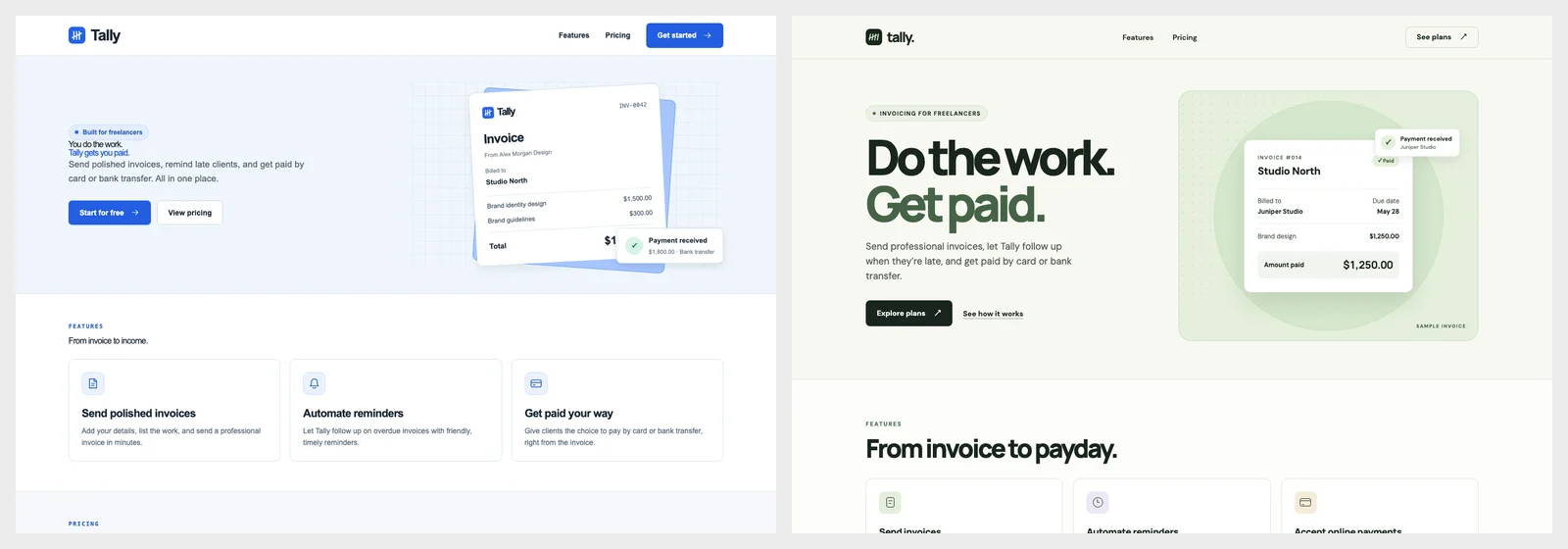
The landing page prompt. Astra on the left, Sol on the right. Astra’s headline should be large; the Tailwind reset shrank it.
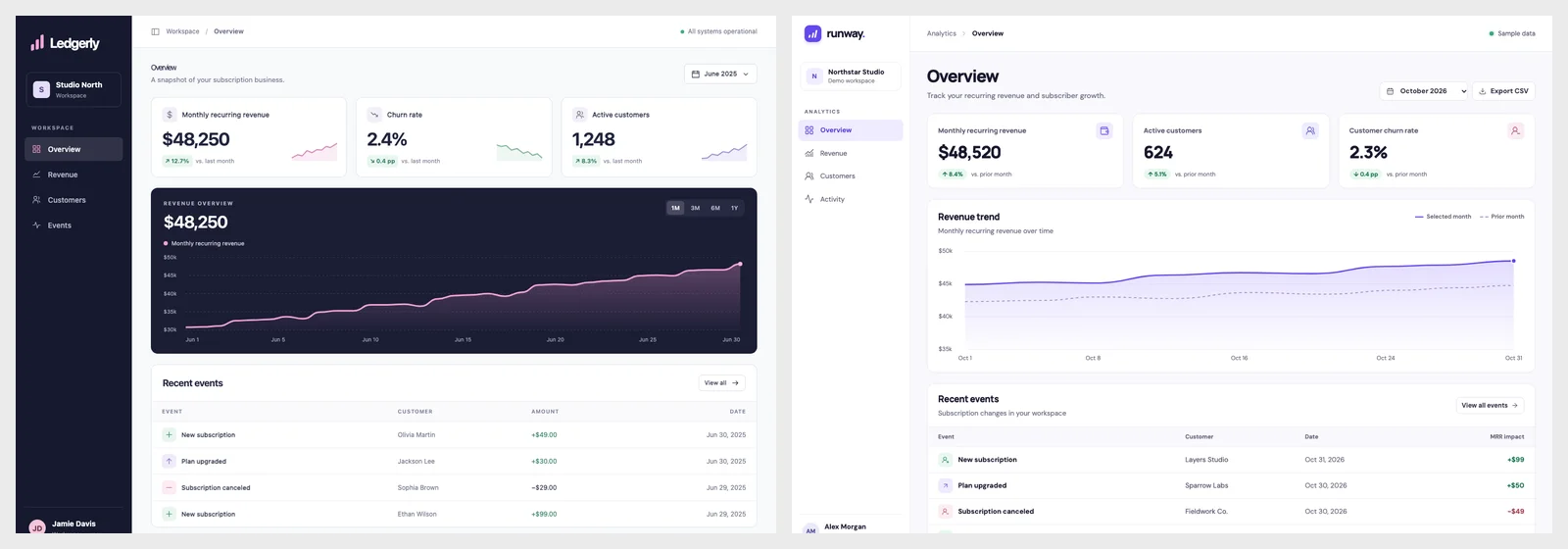
The dashboard prompt. Both put MRR near $48,000 again, like every model we have tested.
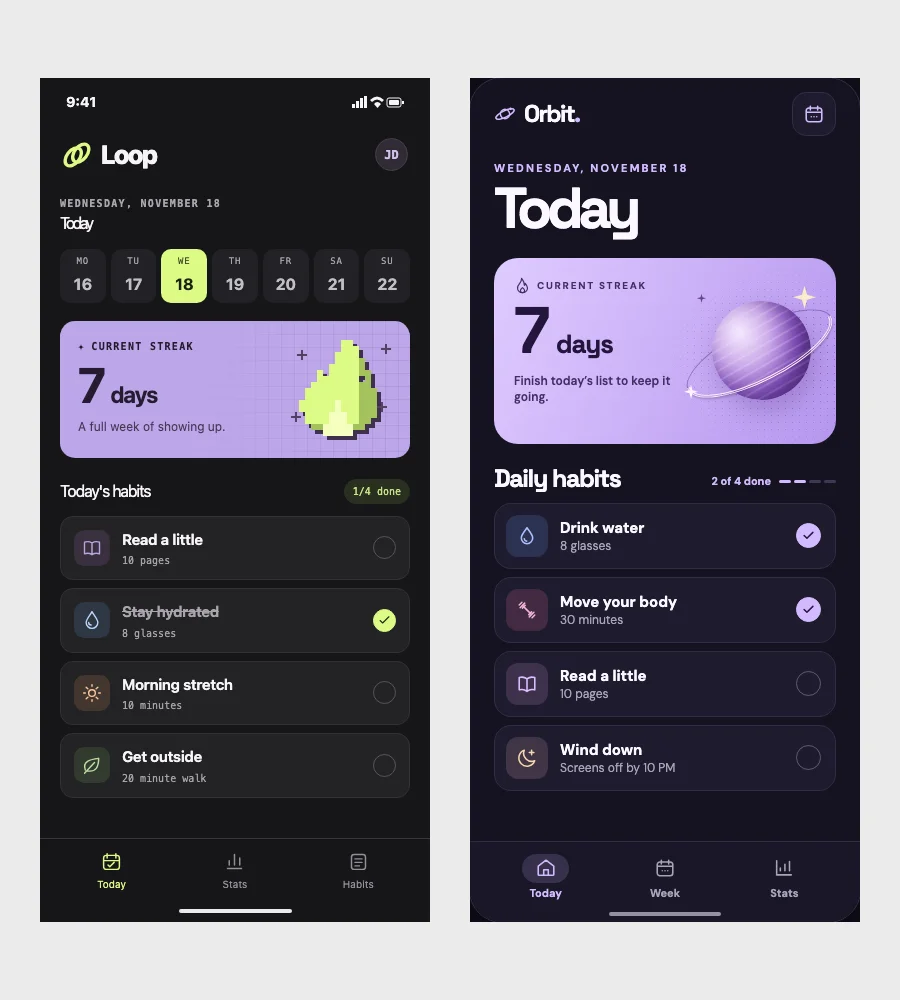
The mobile prompt. Both went dark with a lavender streak card.
| Prompt | Model | Time | Tokens | Fonts | Main color | Checker findings |
|---|---|---|---|---|---|---|
| Landing page | Astra | 1:53 | 28,761 | Inter, no web font loaded | Blue on white | 2 ✓ symbols; Inter |
| Landing page | Sol | 3:34 | 25,889 | DM Sans, Manrope | Dark green on sage | 8 ✓ symbols; 2 all-caps labels |
| Dashboard | Astra | 2:20 | 31,172 | System font | Navy and pink | 0 errors |
| Dashboard | Sol | 4:44 | 35,215 | DM Sans, Manrope | Violet | 0 errors |
| Mobile app | Astra | 1:49 | 27,980 | Inter, a monospace font | Lime and lavender on black | 1 ✦ symbol; a violet gradient |
| Mobile app | Sol | 4:38 | 56,233 | DM Sans, Space Grotesk | Lavender on dark violet | 3 violet gradients |
Token counts are what Codex reported. Both GPT-6.2 models used more tokens than GPT-6.1 on every prompt; Astra used 2.5 to 3 times as many as GPT-6.1 Terra, and Sol’s mobile screen alone took 56,233.
What GPT-6.2 does better
- Real icons. Every icon was an inline SVG. This was GPT-6.1’s most obvious tell, and it is fixed in both models.
- More finished screens. Sol’s dashboard has an export button, a date picker, a prior-month line on the chart, and a “Sample data” label. Astra’s mobile screen has a week strip and a pixel-art flame drawn on a canvas.
- Current dates. Sol dated its dashboard October 2026 and both mobile screens showed today’s date. Astra’s dashboard was stuck in June 2025.
What still goes wrong
- Astra doesn’t look at its own page. The heading bug is easy to see in a browser and easy to fix (load Tailwind first, or use Tailwind classes for type). Ask Astra to open the page and check it, or use a tool that shows you the result as you go.
- Placeholder people. Alex Morgan, Jamie Davis, Olivia Martin, Studio North, and a “JD” avatar. Fable 5.2 wrote more believable content.
- A new shared default. On the mobile prompt both models chose a dark screen, a lavender card, and violet accents, which the checker flags as the old purple-gradient tell. Sol’s landing page is the sage-and-DM-Sans look from GPT-6.1. We keep a list of these patterns in AI UI design tells.
GPT-6.2 vs Claude Fable 5.2 for UI
In our Fable 5.2 test, with the same prompts in Claude Code, Fable 5.2 had zero checker errors on all three screens, wrote more real content, and defaulted to cream with a serif headline. It took 1:39 to 1:55 per screen. Astra was about as fast, with more layout problems; Sol was slower but rendered cleanly.
The pricing is close for Astra and Fable 5.2: both are $8 / $40 per million tokens. Sol is a quarter of that. One public side-by-side, by @EnvolDev on X, ran the same 3D scene prompt on both: Fable 5.2 cost $81.10 and took 1 hour 57 minutes, Astra cost $8.20 and took 41 minutes, and the tester said Fable 5.2 was “still far ahead” for UI design and visuals (original post). Our three small screens are closer than that.
Which one to use for UI design
- Exploring and mocking up quickly: Astra. It is fast, and its layouts have more character, but check every screen in a browser.
- Screens with real behavior, like forms, tables, and flows: Sol. It adds the states you would otherwise ask for, and its output rendered correctly.
- Either way, give it a direction. Both models follow a design system closely when they have one.
To pick a model in the Codex CLI, start it with codex -m gpt-6.2-astra or codex -m gpt-6.2-sol, or use /model inside a session. In the Codex app, choose the model from the picker under the prompt box.
Before building, read DESIGN.md and use only its colors, fonts, radius and spacing. Use Tailwind classes for type, or load Tailwind before your own CSS. Don't use sample names like Alex Morgan or Studio North; use realistic content for [your product]. No small all-caps labels, no purple or violet gradients. Build [the screen], then open it in the browser and fix anything that looks wrong.
Frequently asked questions
Is GPT-6.2 Astra available in Codex?
Yes. OpenAI made GPT-6.2 Astra and Sol available in Codex and ChatGPT Work on November 17, 2026, for Plus, Pro, Enterprise, and Edu users. We ran this test in the Codex CLI with a ChatGPT account.
Is GPT-6.2 Astra better than Sol at design?
Not in our three prompts. Astra’s layouts were a little more distinctive and it was about twice as fast, but all three of its screens had broken headings. Sol’s screens were more complete and rendered correctly. OpenAI’s own 3D ranking puts Astra clearly ahead, so it may do better on larger, more visual work.
Is GPT-6.2 better than Claude Fable 5.2 for UI design?
On these prompts, Fable 5.2 had fewer problems and more realistic content. GPT-6.2 closed the biggest gap, emoji icons, and Sol costs a quarter as much per token. OpenAI reports Astra ahead of Fable 5.2 on AA-3D, a vote on 3D experiences, which is a different kind of task.
How much does GPT-6.2 cost?
On the API, Astra is $8 per million input tokens and $40 per million output tokens; Sol is $2 and $10. In Codex with a ChatGPT plan, both count against your plan’s usage limits. See Codex pricing.
Keep reading
- Claude Fable 5.2 for UI designThe same three prompts on Anthropic’s model, with screenshots and its default look.
- GPT-6.1 Terra vs Sol for UI designThe previous GPT models on the same prompts, and the sage-green look they share.
- AI UI design tells, and how to avoid themTwelve signs a UI looks AI-made, and prompts that fix each one.
- Codex pricingPlans, usage limits, and how many credits each model uses.